
Lower Back Pain — A Complete Guide
Whether your pain developed suddenly or has been building for years, understanding what's happening is the first step to getting better.
This guide is for you if:
Your back pain came on yesterday, or it's been fifteen years
You've had one scan, three opinions, and still don't know what's actually wrong
You're an athlete, a lifter, a desk worker, or just a person with a spine
You want to understand what's happening, not just be told to "strengthen your core"
You're looking for management, not a miracle cure
Lower back pain is one of the most common reasons people visit an osteopath — and one of the most misunderstood. Whether it came on suddenly after lifting something awkward, or has been building gradually for months, the experience is the same: it affects everything. How you sleep, how you sit, how you move through your day. This guide is written to help you understand what's actually happening, what tends to make it better or worse, and how hands-on osteopathic treatment can help — whether you're in the middle of a flare-up or trying to prevent the next one.
Find what you need:
Why I wrote
this guide
I've had lower back pain since I was 12 or 13 years old.
As a kid I was relentlessly active — rugby in the morning, football in the afternoon. My back was a constant companion in the wrong way. I saw physios, chiropractors and osteopaths throughout my teens, found most benefit from osteopathy even if I now suspect my diagnosis wasn't quite right, and learned to manage around it rather than through it.
It's only through years of clinical training and obsessive personal research that I've come to understand what was probably happening all along — a disc injury that was never properly identified, influencing everything from how I moved to how much pain I was in on any given day.
I’m actually somewhat injury prone, which is ironic or fortunate considering my profession. I've had the bone-deep, gnawing pain of sciatica radiating down my leg. I've had facet joint episodes so acute I couldn't stand straight for two days. I know what it feels like when back pain stops you doing the things you love. I also know the frustration in not knowing why it happened, what it is and how to fix it.
These days I'm mostly pain free. I can run, swim, lift weights and look forward to playing with my son without my back dictating the terms. My rugby days are behind me — but that's a fair trade. What I've learned is that the goal isn't to fix or cure back pain. We are living, dynamic bodies.
“We aren't always going to be pain free and that's okay — that's normal. The goal is management, understanding and building a body that's resilient enough to get on with life.”
Everything in this guide is the result of years of clinical experience combined with the kind of motivated personal research you only do when you're desperate to fix yourself.
I wrote it because I wish someone had handed it to me when I was a teenager.
What's actually causing your lower back pain?
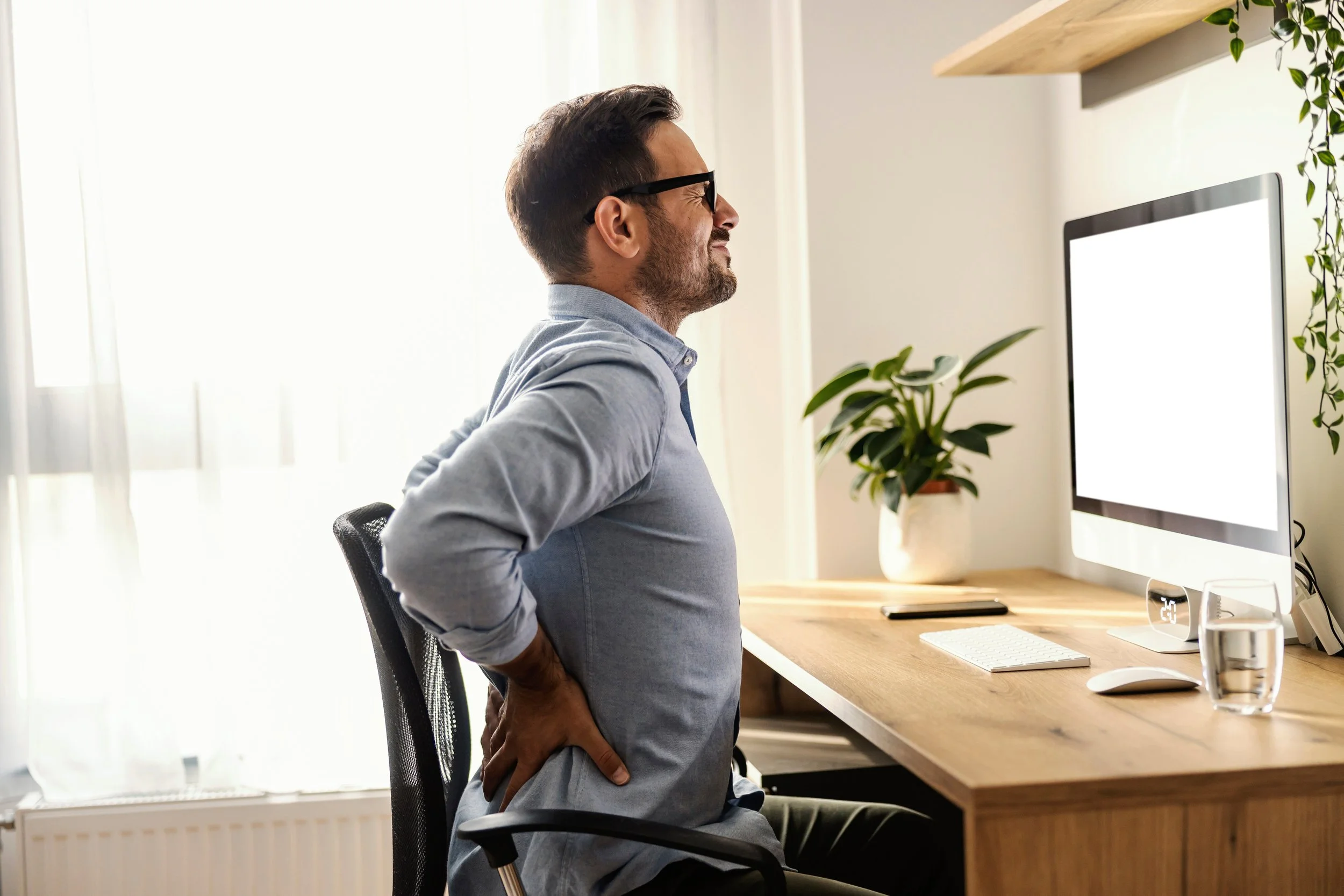
Red Flags
Before we go further — while the vast majority of lower back pain is musculoskeletal in origin, there are symptoms that warrant urgent medical attention:
Sudden loss of bladder or bowel control (incontinence)
numbness or tingling in the saddle area — the region you'd sit on a bike.
Bilateral leg symptoms (numbness, weakness, or pain in both legs together)
Sexual dysfunction (new-onset numbness or altered sensation in the genital area, or new erectile/sexual difficulty
Progressive leg weakness (not just numbness, but genuine motor weakness — foot drop, difficulty walking)
These can be signs of cauda equina syndrome, a rare but serious condition requiring emergency assessment — go straight to A&E, don't wait for a GP appointment. These symptoms can occur independently without indicating cauda equina, but together, or if severe, they should always be taken seriously.
Lower back pain can occasionally be a symptom of something other than a musculoskeletal problem. Things to be aware of include:
unexplained, severe weight loss
pain that is unrelated to movement or position
pain that is progressively worsening without any mechanical pattern.
If any of these apply to you, it's worth speaking to your GP before seeking osteopathic treatment.
If you're in any doubt, feel free to contact me directly and I'm happy to advise.
What’s Most Likely Going On:
You may have heard the term "non-specific lower back pain" — a label used when no single identifiable cause can be confirmed. While it's commonly used, in my experience most lower back pain does trace back to a specific tissue; the challenge is identifying which one is the primary driver of your pain. The causes below represent the most common sources and the structures most likely to be involved.
Most people arrive at this section with the same question — what's wrong with me? The honest answer is that without a proper assessment it's impossible to say for certain. Lower back pain rarely announces itself with a clear label. You just know it hurts, and you want it to stop.
“The lower back is a complex structure — vertebrae, discs, joints, muscles, ligaments and nerves all working together to keep you upright, mobile and absorbing load.”
When something goes wrong, several of these tissues are often involved and responding at once — muscles guarding, joints stiffening, nerves irritated — which is part of why back pain can feel so all-consuming. But that doesn't mean there isn't a driver. In most cases, one structure is the primary source, and everything else is reacting to it. Identifying that structure is what changes a vague "it just hurts" into something we can actually treat directly.
What I can tell you is that most lower back pain comes from a relatively small number of causes. Some of them I've experienced personally. All of them respond well to the right treatment approach.
-
The disc sits between each vertebra acting as both a shock absorber and an enabler of movement. That dual function means it bears more load than any other structure in the spine — more than the surrounding muscles, more than the joints. When the outer casing is compromised — through injury, load or gradual wear — the inner material can bulge or push outward, irritating surrounding structures and sometimes compressing nearby nerves.
Disc injuries are far more common than most people realise, and a diagnosis doesn't mean surgery or a lifetime of pain. The vast majority respond well to hands-on treatment, movement and load management. The key is understanding what's happening and addressing it properly.
Read more about disc injuries here: Slipped disc, prolapse, or herniation?
-
The facet joints run down either side of the spine and guide how your vertebrae move relative to each other. When they become irritated or inflamed — through sudden movement, sustained or extended posture, rotation, or gradual wear — the pain can be sharp, localised and severe. It's often worse bending backwards or twisting, and can cause a visible lean to one side as the body instinctively offloads the painful joint.
I've had episodes where I couldn't stand straight for two days. It feels alarming but it typically settles well with the right treatment.
Read more about facet joint pain here: Facet Capsule Irritation, and back pain?
-
When disc material irritates the sciatic nerve, pain can travel from the lower back down through the buttock and into the leg — sometimes as far as the foot. Joint and bone irritation can also refer pain into the leg, though through a different mechanism. The quality of true sciatica is distinctive — gnawing, burning, sometimes electric. I've been there. It's one of the most distressing presentations I treat, and one of the most satisfying to resolve. Read more about sciatica here: Understanding Sciatica & what to do — Holland Osteopathy.
-
The sacroiliac (SI) joints sit either side of the base of your spine, connecting the sacrum to the pelvis — a different joint to the facet joints further up the spine, with a different job: transferring load between your upper body and legs rather than enabling spinal movement. Here's the important bit though — in my experience, pain felt at the SI joint is very often disc-referred rather than driven by the SI joint itself. The way load transfers through the pelvis means the disc can be the structure doing most of the work, even when what you actually feel is squarely over the SI joint. True SI joint dysfunction does exist, but it's less often the primary driver than the location alone would suggest, and distinguishing between the two isn't something you can reliably do just by where it hurts — it needs a proper assessment. If you're feeling pain at the SI joint, it's genuinely worth not assuming you know what's causing it.
-
What most people describe as a pulled muscle in the back is usually a secondary response — muscle spasm around an injury to another structure rather than a primary muscle tear. True muscle strains are less common in the back than people think. A proper assessment will identify what the muscles are actually reacting to.
The exception is muscular fatigue — common in people sustaining prolonged standing or loaded postures where the lumbar muscles are working continuously. This produces a deep, aching pain that builds gradually under load and is temporarily relieved by movement. A proper assessment will distinguish between the two.
Read more here: Pulled a Muscle in Your Lower Back? It's Probably Not That
Ligaments connect bone to bone and are designed to tough and resistant to load. In the spine they play a crucial role in stability — the posterior longitudinal ligament, for example, acts as a restraint against disc herniation. True ligament sprains in the lower back do occur, typically following significant trauma, but are far less common than people assume. Like muscle pain, ligament pain in the back is often a secondary response to injury elsewhere rather than the primary cause.
-
Despite the name, degenerative disc disease isn't a disease and it isn't necessarily a life sentence. It describes the natural ageing process of the discs — they lose some hydration and height over time, which can cause pain and stiffness. Most people over 40 have some degree of disc degeneration on imaging. One study on 15 year olds showed that about 1/3 had some signs of degeneration. So degeneration isn't purely an age related phenomenon either. What matters is how it's managed, not how it looks on a scan. Read more about degenerative disc disease here: Degenerative Disc Disease: Symptoms & Treatment Options?
-
Spondylosis is arthritis of the spine — age related changes to the vertebrae and facet joints that can cause stiffness, aching and sometimes nerve irritation. While degenerative disc disease primarily affects the discs between vertebrae, spondylosis describes changes to the bony structures and joints themselves. The two frequently coexist. Like DDD, the presence of spondylosis on a scan doesn't automatically mean you'll be in pain — many people have significant changes on imaging and minimal symptoms. Treatment focuses on keeping you moving well and managing flare-ups.
Read more here: Osteoarthritis of the spine (spondylosis).
-
Spondylolisthesis occurs when one vertebra slips forward over the one below it. This can happen as a result of trauma, a stress fracture in the vertebral arch, or gradual degeneration of the facet joints and discs that normally keep the vertebrae aligned. Depending on the degree of slippage, it can cause local lower back pain, stiffness, and in some cases nerve symptoms if the displaced vertebra narrows the spinal canal or compresses nearby nerve roots. It's less common than the other causes covered here but worth knowing about — particularly if your pain came on after significant trauma or has a notable instability quality to it. Most people with spondylolisthesis manage well with the right conservative approach.
Read more about spondylolisthesis here: Spondylolisthesis — What It Is and What It Means for Your Back
Does this sound like you?
Lower back pain doesn't affect everyone the same way — what's driving it, and what tends to help, often depends on how you use your body day to day. The patterns below aren't rigid categories; they're tendencies, not rules, and many people will recognise themselves in more than one. Find the one that sounds most like you to start.
-
Pain that flares with rotation, sprinting, or impact often comes down to training load rather than lasting damage. Rotational sports and running load the spine through repeated impact and twisting, which tends to aggravate disc and facet joint tissue rather than cause new injury outright. The key distinction I'm looking for is whether this is a load management issue — pain that builds with volume and eases with rest — or something needing more caution, like pain that doesn't settle with reduced training or comes with neurological symptoms. Most sports-related back pain responds well once we identify what's driving it and adjust load accordingly, not by stopping activity altogether.
-
Pain under load often ties back to lumbar flexion or bracing technique rather than the weight itself. Lifting puts the spine under compressive and shear forces, and how well you tolerate that comes down largely to technique — particularly how much lumbar flexion happens under load, and how effectively you're bracing. Interestingly, technique often isn't the problem when things start — it's what happens as fatigue sets in. I regularly see people with genuinely good form who hold it together for most of a session, then lose it on the last few reps or the last set of the day, and that's exactly when injury tends to happen. This is rarely about lifting being "bad for your back"; it's about the specific pattern — and the point in a session — where tissue gets loaded unevenly. Part of what I do here is identify whether it's a technique issue, a fatigue-management issue, or an underlying tissue sensitivity that needs addressing before you load it further.
-
Growing bodies have their own back pain causes, and this age group needs a different lens entirely. Growth-related changes, conditions like Scheuermann's, and a higher relative risk of spondylolysis (particularly in sports involving repeated extension, like gymnastics or fast bowling) mean teenagers need their own assessment approach rather than a smaller version of adult treatment. Disc injury is also far more common in this age group than people expect — mine started as a teenager, and it's often where the whole picture begins for a lot of people I see. I wrote this guide partly because I wish someone had explained this distinction to me at that age — persistent pain in a teenager is worth taking seriously and looking at properly, not just waiting out.
-
Pain in this group tends to show up in one of a few ways: a dull ache that builds gradually through the day or week, a flare after an unaccustomed activity (a long walk, a weekend of gardening, moving furniture), or pain that seems to come from nowhere. That last one is worth a caveat — most pain that "comes out of nowhere" actually has a build-up we didn't notice, whether that's weeks of poor sitting posture, tightening hip flexors, or general deconditioning quietly lowering your tissue's tolerance until something ordinary tips it over. This group frequently benefits as much from addressing movement habits and hip/core conditioning as from hands-on treatment alone.
-
What's driving your pain often shifts with age, and it's worth knowing which pattern fits you. Younger backs more commonly present with disc-driven pain — the disc is more hydrated and load-bearing capacity is high, so injury here tends to dominate. As we age, degenerative changes shift more load onto the facet joints, and presentations become more commonly facet- or stenosis-driven, with different aggravating factors (extension and standing tend to worsen facet/stenosis pain, whereas flexion often worsens disc pain). Neither pattern is fixed to an age — it's a tendency, not a rule.
When To See An Osteopath
If you've got any of the red flag symptoms covered earlier — numbness in the saddle region, loss of bladder or bowel control, or symptoms in both legs at the same time— that's a same-day medical attention situation, not an osteopathy appointment. Some numbness or altered sensation in one leg on its own is common with back pain and isn't automatically a red flag.
This section is about everything else: the much more common, much less dangerous back pain that still leaves you wondering whether it's worth getting looked at.
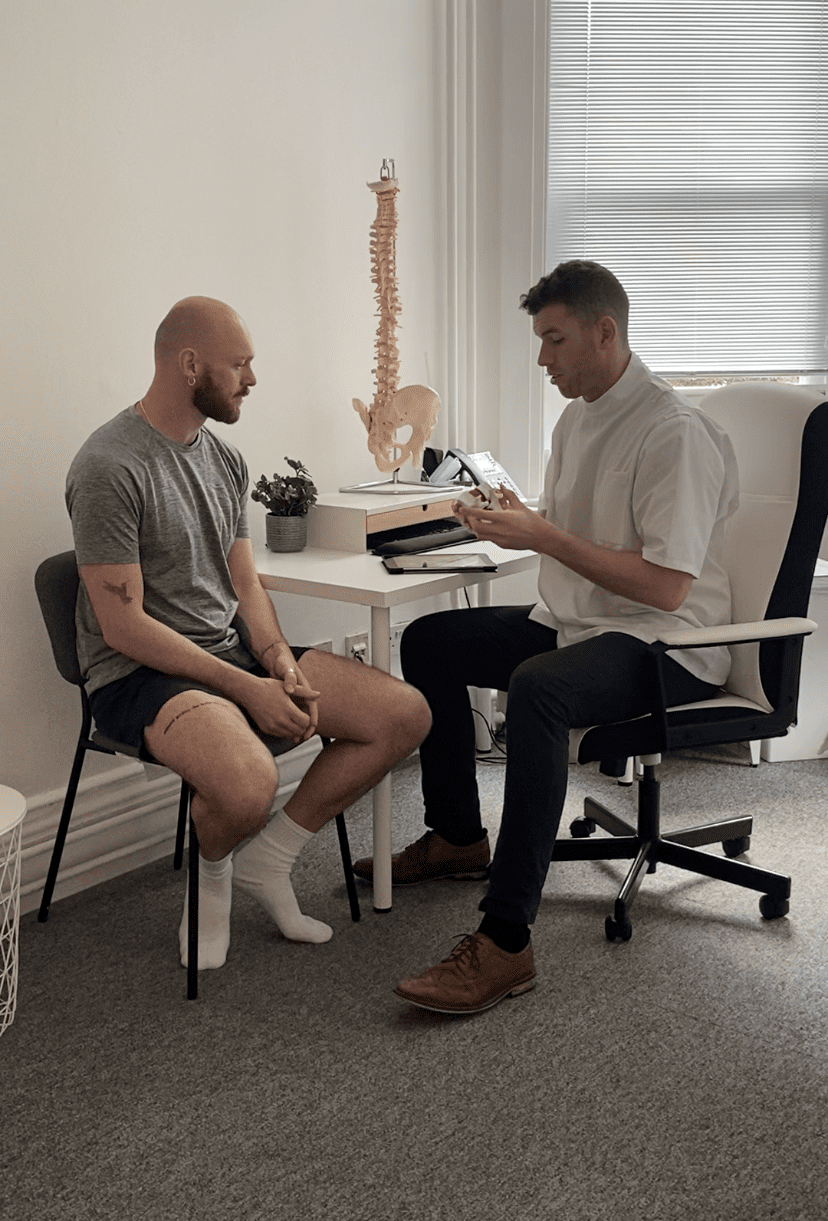
Can I just wait and see if it goes away
on its own?
Honestly, probably. Osteopathy is mostly there to help with pain and nudge you along the road to being symptom-free — but your body is the best healer you've got, and movement is what it needs to do that job. I'm not trying to replace that process, just support it.
That said, there's a difference between resting while it settles and waiting and hoping. If it's still bothering you after one to two weeks, that's usually the point where waiting stops being a reasonable strategy. And if this is a symptom or injury you haven't experienced before — somewhere new, or a different quality of pain than you're used to — I'd get that looked at sooner rather than later. Long-term management is what I'm aiming for with most people, which means understanding a new pattern early rather than guessing at it later.
Signs it's worth booking in, even without a red flag
It's been going on for more than a week or two with no real improvement
It's happened before — this isn't your first episode
It's affecting your sleep, your work, or things you'd normally do without thinking
You've made changes yourself (rest, stretching, painkillers) and it's not shifting
It's a new symptom or injury type you haven't had before
You just don't know what's causing it, and that uncertainty is part of what's bothering you
You don't have to wait until it's bad
You don't need to be in agony to justify an appointment. In my experience, the back pain that's easiest to make real progress with is often the pain that hasn't been left to become a habit yet — where we're managing an episode, not untangling months of guarding, altered movement, and muscle compensation that built up around it. Catching it early isn't overreacting. It's usually the quickest route back to normal.
Not everyone reading this can book in with me
A lot of people reading this guide won't be local to me, or won't be able to get an appointment in a timeframe that suits them — and that's fine. This guide isn't meant to only be useful if you can see me specifically. If that's you, it doesn't stop you finding a good therapist elsewhere, whether that's another osteopath, a physiotherapist, or someone else entirely.
I can't vouch for the quality of therapists I haven't met, but as a general rule: anyone who treats you hands-on and understands movement — not just one or the other — is normally on the right track.
Treatment & Approach
My approach is built on two things working together: hands-on treatment, and movement. Neither one does the whole job on its own.
Hands-on work:
Mobilises stiff joints
Releases tight or guarding muscles
Eases restricted movement
Calms things down enough that you can move more freely again
But movement is what actually builds the tissue tolerance and resilience that keeps you out of pain long-term. One without the other only gets you half the result.
Movement is medicine.
I don't commit to a fixed number of sessions upfront, and I'd be wary of anyone who does. There are general patterns for how long these things take to settle, but they're just that — general. How quickly you respond depends on how long you've had it, how severe it is, and how your body responds to the first bit of treatment, so I'd rather see how you actually respond than promise a number before I've even assessed you.
The first session is deliberately not about handing you a list of exercises. I want to see how you respond to hands-on treatment first, and get a feel for how your body tolerates loading and deloading — what makes things better or worse in the room, not just what you've told me over the phone. Specific exercises come after that, once I've got a clearer picture of what you actually need, rather than a generic sheet handed out to everyone with "back pain."
Self Management
Treatment can help calm things down, but what you do between appointments — and after you're done needing them — matters just as much, if not more. Your body is the best healer you've got; the goal of self-management isn't to replace that, it's to stop getting in its way.
A quick caveat first: Same principle as treatment: without seeing how you move and what's actually going on, a stretch or exercise that helps one person can just as easily aggravate another. There's no single routine that's right for every back, so what follows is general guidance that's safe for most people, not a treatment plan.
Stay moving
The single most consistent thing that helps is staying as active as you reasonably can. Prolonged rest tends to make back pain worse, not better — stiffness builds, deconditioning sets in, and the tissue that needed to adapt never gets the chance to. Walking is one of the simplest, lowest-risk ways to keep moving without adding significant load, and it's a good default when you're not sure what else to do.
Pace yourself, don't avoid entirely
There's a difference between protecting yourself and avoiding everything that causes any discomfort. Total avoidance tends to backfire — it shrinks what your body can tolerate rather than building it back up. Pacing means doing what you can, noticing if something flares things up, and adjusting rather than stopping altogether.
Build load back gradually
If you've backed off an activity — running, lifting, sport — because of pain, the way back in matters. Jumping straight back to your previous volume or intensity is a common way to re-aggravate things. I think of building load back the same way I think about adding salt to food: you can always add more, but once you've added too much, you can't take it away. Building gradually gives tissue time to adapt to what you're asking of it again, rather than overshooting and having to backtrack.
Reach for Ice first
A lot of back pain has an inflammatory element to it, and ice/cold works on a similar principle to anti-inflammatories like ibuprofen or naproxen — calming that inflammatory response down. That's why I generally lean toward recommending ice over heat, particularly where there's a clear inflammatory driver. Heat still has its place — mainly for general muscular tension and stiffness, where there's less inflammation and more just tightness to ease — but as a default, ice is usually the better first reach.
There’s no perfect sleeping position
There's no single perfect sleeping position, mattress, or pillow setup — whatever position you can actually fall asleep in easily tends to be the best one for you, and fighting that in search of some theoretically "correct" position usually isn't worth it. That said, there are adjustments that can make sleep less aggravating — support in the right places, avoiding positions that leave your lower back twisted or unsupported for hours at a time. It's also worth knowing that some of what happens to your spine overnight is simply unavoidable — your discs rehydrate and change slightly in height as you lie down, which is a normal part of why backs can feel stiffer first thing in the morning, not a sign that anything's gone wrong.
Notice your posture, don't obsess over it
Posture matters less than the fitness industry sometimes makes out, but prolonged static positions — however "correct" — still add up. The most useful posture advice isn't a specific position to hold; it's changing position regularly, rather than staying locked in any one posture, good or bad, for hours at a time.
Pregnancy & Lower Back Pain

Pregnancy puts the spine and pelvis through a lot of change. Hormones soften the ligaments and alter how much load your joints can handle, while the extra weight and a shifting centre of gravity increase the demand on your back. Back pain is very common as a result, and it's not something you have to put up with.
Pelvic girdle pain (PGP) or Symphysis pubis dysfunction (SPD) is related but worth separating out, since it's a different mechanical problem. Pain can develop around the pelvis, hips, or pubic area, and is often linked to how the joints of the pelvis are managing the same ligament-softening and load changes, rather than the spine itself. It can feel similar to lower back pain but often responds to a different approach, so it's worth differentiating the two primary causes of pain.
Treatment through pregnancy is gentle and non-invasive, and aims to support your body through these changes rather than fight against them — most people find real relief is possible without needing to just wait it out until after birth.
For a full breakdown of what's happening and how it's treated, see pregnancy and pelvic girdle pain blog.
More Support
Want to go further than this guide?
I'm working on more in-depth resources to help you manage your back pain — going beyond what a guide alone can cover. Check back here, or get in touch if you'd like to be notified when they're ready.

Frequently Asked Questions
-
Usually, no. Most lower back pain doesn't need imaging to be understood or treated — a scan tells you what your spine looks like, not necessarily what's actually causing your pain, since things like disc bulges and degenerative changes show up on scans of plenty of pain-free people too. Imaging becomes genuinely useful when there are red flag symptoms, when pain isn't responding to appropriate treatment over a reasonable period, or when it would actually change what happens next. For most people, a thorough physical assessment tells us what we need to know.
-
It might, and that doesn't mean treatment failed or anything's gone wrong. Bodies that move, load, and do things aren't always going to be pain-free forever — that's true for everyone, not just people with a back pain history. The goal isn't to guarantee you'll never feel your back again; it's to understand your pattern well enough that when something flares up, you know what's going on, what to do about it, and that it's manageable rather than alarming.
-
In most cases, yes — and you often should. Inactivity tends to make back pain worse, not better, through stiffness and deconditioning. The real question usually isn't "should I stop," it's "what needs adjusting" — volume, intensity, or technique — while things settle. Complete rest is rarely the right call unless you're dealing with a genuine red flag.
-
Recurring episodes are common, and on their own don't mean something's seriously wrong. Backs are dynamic — they respond to load, fatigue, life circumstances, and how much you've been moving or not moving. What's worth paying attention to is whether episodes are getting more frequent, more severe, or lasting longer each time, since that pattern is more informative than any single flare-up in isolation.
-
Yes. It’s fairly well researched that stress, anxiety etc can manifest physically. Stress affects muscle tension, sleep, and how sensitive your nervous system is to pain signals generally, all of which can make an existing back issue feel worse, even if nothing structural has changed. It's rarely the sole cause, but it's a real factor that can contribute to symptoms.
For more information check out my blog on the biopsychosocial model of pain. -
Not exactly — degenerative changes are a normal part of aging, but pain isn't an inevitable consequence of them. Plenty of people have significant degenerative findings on a scan with little or no pain, and plenty of younger people with "normal" scans have significant pain. Degenerative changes turn up on scans of younger people too, so it's not purely an age thing — degeneration is partly the body's way of adapting to load over time, at any age. Age changes what's likely to be going on structurally, but it doesn't mean you're just supposed to put up with pain because of it.